
The man who took a year off and realized he forgot how to rest
- Muhammad Ali Tariq

- Jan 18
- 5 min read

Most men don’t burn out because they’re lazy.
They burn out because they only know one speed.
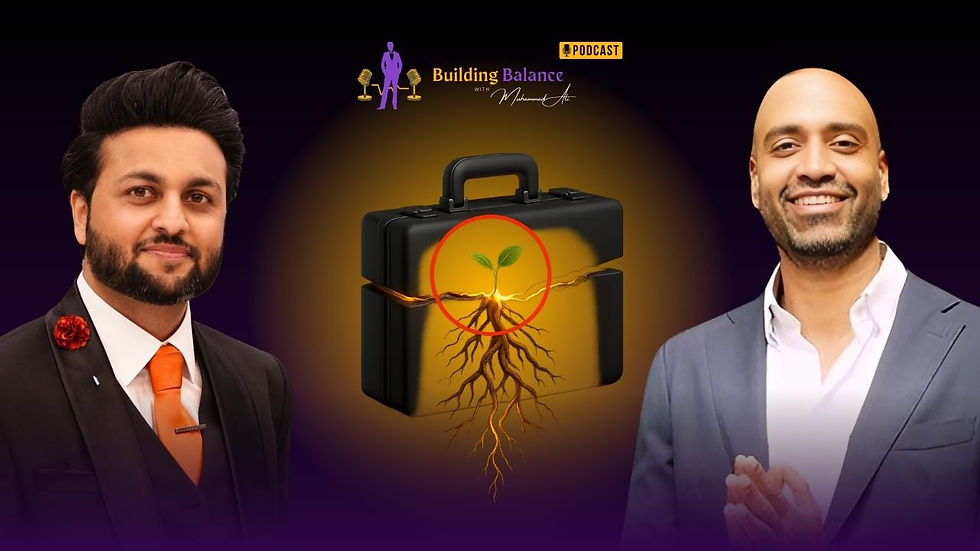
That’s why this episode with Robin Macpherson hit me so hard. He’s a seasoned legal and risk executive, 20+ years deep in global banking, finance, and real estate. He’s done the big careers, the high standards, the long hours. Then he took a year out.
And here’s the part that surprised even him:
He had to learn how to rest.
Not “switch from emails to errands” rest. Real rest. The kind that actually puts your nervous system back together.
If you’re a man trying to juggle career pressure, marriage, fatherhood, and your own mental health, this conversation is for you.
What people are searching that this episode answers
This episode naturally covers questions that men are typing into Google late at night:
How to rest properly when you’re burned out
How to balance work and family without losing yourself
How to be a better listener in a relationship
How to parent a child with ADHD and stay patient
Do I need a mentor and how do mentors actually help (work-life/career guidance is a common theme in mentoring programs and work-life reflection content)
Now let’s turn those searches into real-life answers.
1) The rest trap: doing “non-work” in a work way
Robin said something that describes a lot of ambitious men perfectly:
You take a break, but you structure it like a project.
Gym, book, swim, driving range… stacked like a productivity playlist. Then you end the day exhausted and call it “rest.”
That’s not rest. That’s just achievement wearing a hoodie.
A quick gut-check:
If you feel guilty when you sit still, you’re not resting.
If you need to “earn” relaxation, you’re not resting.
If you’re tired after your “break day,” your body is telling you the truth.
Gold takeaway: Rest is not time off. Rest is a nervous system skill.
Try this today: Pick one 15-minute block this week where you do nothing on purpose. No phone, no “useful” tasks, no background podcast. Just sit, walk, breathe, stare at the sky.
Train your system to feel safe without productivity.
2) The invisible disadvantage: being the first one in the room
Robin opened up about something many men relate to but rarely say clearly:
He didn’t come from a world where people explained the professional game.
He studied law, but didn’t grow up around terms like M&A, IPO, leverage finance. He didn’t have the “my dad reads the Financial Times at breakfast” type of exposure.
If you’re first-gen, immigrant, working-class, or just not from that world, your learning curve is steeper.
And here’s the danger: you blame yourself for not knowing what nobody taught you.
Gold takeaway: Lack of exposure is not lack of intelligence.
This is where Robin’s mentorship message matters. A mentor isn’t magic. It’s simply someone who has been there and can save you years of confusion.
Simple mentor move:Find one person 5 to 10 years ahead of you and ask one focused question:“Looking back, what would you stop doing earlier if you were me?”
3) The long-game mindset: stop rushing your whole life
Robin told a story about a mentor who asked him a question that every young man needs to hear:
“What’s your rush?”
That question can offend you when you’re 25. It can save you when you’re 35.
Because the truth is, most men sprint their career, then wonder why their marriage,
health, friendships, and inner peace couldn’t keep up.
Your career is long. Your life is longer.
Gold takeaway: Consistency beats intensity when you’re building a life, not just a resume.
4) The best decision you will ever make is your partner
Robin didn’t hesitate on this:
The best decision he ever made was marrying his wife.
Not because marriage is easy. He’s very honest that seasons change. You don’t show up the same in year 2 as year 12. You mature, you learn, you get humbled.
But he made a point that’s worth repeating:
If you and your partner are not on the same page, that mismatch becomes a permanent stress source.
And when a man lives in constant relational stress, everything else suffers:
his focus
his career momentum
his fatherhood
his energy
his identity
Gold takeaway: Your relationship can become either your battery or your leak.
5) Listening is love, but most men don’t know how
Robin broke down a hard truth:
Most of us don’t listen to understand. We listen with our “response loaded.”
You’re hearing her, but you’re already preparing your comeback. That’s not listening. That’s debate.
He also touched something deeper: sometimes you can’t listen because you’re triggered. That’s baggage. That’s unprocessed stress. That’s ego trying to protect you.
A simple listening reset you can use tonight:
Put your phone away.
Let her finish.
Repeat back what you heard: “So what I’m hearing is…”
Ask one gentle question: “What do you need from me right now, advice or support?”
That one question alone saves arguments.
6) Perfecto Casa in one sentence: self, relationships, finances
We talked about the Perfecto Casa framework in this episode, and Robin agreed with the core idea:
If one pillar is out of balance, life doesn’t feel fulfilling.
But he added something men need to hear:
Self-care is the one that gets neglected most, because men tie their identity to providing.
The airplane rule is real: you put your mask on first, not because you’re selfish, but because you want to stay alive for the people you love.
Gold takeaway: Taking care of yourself is not a luxury. It’s family leadership.
7) Fatherhood and ADHD: compassion, structure, and the “floordrobe”
This part was powerful.
Robin talked about raising neurodivergent kids, and he gave his wife huge credit for leading the family through education, empathy, and better systems.
One small story said everything: instead of raging at a messy room, they brought humor into it. The “wardrobe on the floor” became the “floordrobe.”
That sounds small. It’s not.
That’s the difference between:
parenting with frustration
parenting with understanding
He also made a key distinction: ADHD explains a lot, but we shouldn’t dump every bad habit into the ADHD bucket. Kids still need scaffolding, tools, and accountability, delivered with kindness.
If you’re a father who suspects your child is neurodivergent, Robin’s advice was clear:
Educate yourself. Learn what your child is experiencing, then build support around them.
Gold takeaway: We don’t blame a kid for poor eyesight. We give them glasses. Your job is to give your child what helps them see the world clearly.
The one principle Robin wants you to take today
Be kind to yourself, and be true to who you are.
You’re going to have off days. You’re going to lose sometimes. You’re going to feel behind. That’s normal.
The goal isn’t to be perfect.
The goal is to reset and go again without hating yourself in the process.
Watch the full episode and subscribe
This episode is for the man who wants to build a meaningful career without sacrificing his marriage, his health, or his kids.
We host Building Balance with Muhammad Ali on our YouTube channel Perfecto Casa.
If this article gave you value, the episode will give you the real thing: Robin’s stories, tone, and the details that don’t translate fully on the page.
Subscribe to Perfecto Casa and join the mission: to empower young men to build balanced and fulfilling lives through self-care, relationships, and finances.


Comments