
From the US to the Netherlands: The Power of Networking (ft. Charles “Ruf” Ruffolo)
- Muhammad Ali Tariq

- Jan 12
- 6 min read

If you are building a life in the Netherlands, you already know the truth no one says out loud.
It is not just about talent.
It is not just about working hard.
It is not even just about speaking Dutch (although it helps).
The real game is this: getting opportunities in a country where you did not grow up, did not go to school, and do not have decades of shared history.
This is a practical guide to networking in the Netherlands (and what still applies if you’re building your career in the US).
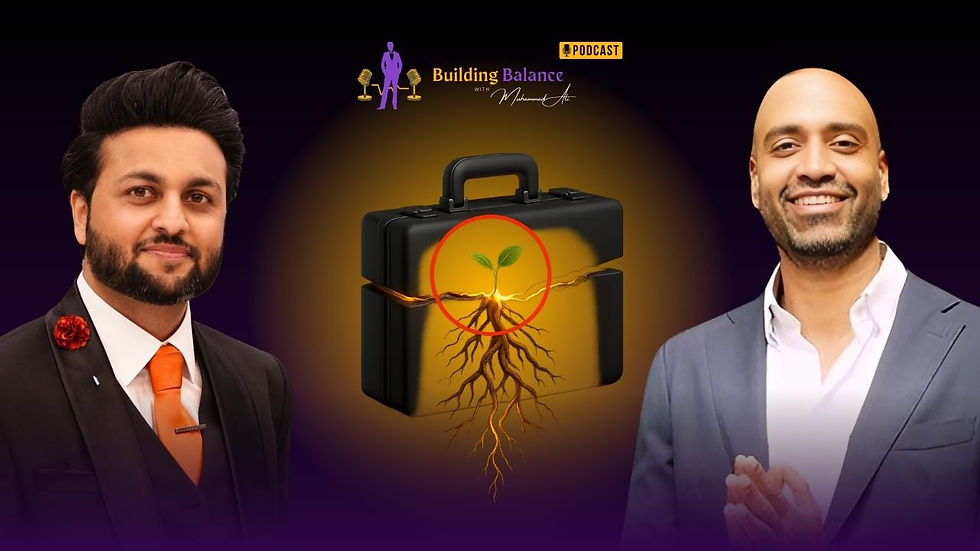
That is why this episode of Building Balance with Muhammad Ali is one of the most practical conversations we have had so far.
Because my guest, Charles “Ruf” Ruffolo, did exactly what many people struggle to do:
He moved from the US to the Netherlands, rebuilt his life, and turned connection into a calling.
He is a US Army veteran, an MBA, founder of “NetworKing,” and the force behind the Giving Back Foundation, a mentorship pipeline helping motivated students (often with immigrant backgrounds) access networks, coaching, and internships.
But this is not an episode about hype networking. It is not about collecting business cards. It is not about being “extroverted.”
This is about how to become known and trusted, especially when you are an outsider.
And yes, if you are in the Netherlands, this matters even more because trust and consistency are the currency.
The moment that captured the whole episode
Mid-conversation, Ruf reaches off-screen and comes back holding something unexpected: a portrait of Muhammad Ali (the boxer).
He explains that it was a gift from Muhammad Ali’s wife, someone Ruf knows personally, and that seeing my name “Muhammad Ali” instantly triggered that connection in his memory.
This is the part you cannot fake.
It is not “networking tricks.”
It is proof that relationships compound over time, and sometimes a single name, moment, or shared reference opens a door that was never even on your radar.

Why this episode is especially for the Netherlands (and then the US)
In the Netherlands, people generally value:
Normal behavior (doe normaal)
Consistency over charisma
Directness over performance
Reliability over big talk
If you are new here, you can misread the room easily.
You might think you are being ignored. You might think “networking does not work here.”
You might think you need to become someone else to be accepted.
We discussed a similar theme on Sergio’s podcast, where we talked about being an outsider in the Netherlands, learning the culture, and why choosing the right partner matters if you want stability while building a life abroad.
Mentioning that here is important because networking is not separate from life.
Your network affects your career, yes.
But your partner affects your decisions, your circles, your energy, your confidence, and your ability to show up consistently. If you choose wrong, your life becomes survival mode. If you choose right, your life becomes momentum.
Ruf’s core belief: networking is not a skill, it is a way of living
Ruf’s story starts in Pittsburgh in a big Italian-American family, then the Army at 18, then the Netherlands in the 1970s, where he met his wife Harma and later built a second career.
But what stood out most is his philosophy:
Networking is not something you turn on when you need something.
Networking is something you live every day because it comes from your values:
how you treat people
how you show up
how you follow through
how you give
And that is what makes it powerful in the Netherlands, because Dutch culture respects people who are consistent.
Today, reach out to one person to encourage them without asking for anything.
The social media trap: why so many young men feel lost
Here is what I see constantly in the Netherlands and in the US:
A young man is doing okay, but not great.
He opens social media.
He sees someone living a life that looks unreal:
Money. Travel. Status. Perfect relationship. Perfect confidence.
And now he feels behind.
Now he feels like a failure.
Now he starts copying a lifestyle that is not even real.
Ruf speaks directly to this in one of the Shorts.
His message is simple: your strongest story is not borrowed from the internet. It is built from what is already inside your real life - your experiences, your resilience, your hard lessons, your character.
And when life gets hard, internet inspiration is not the same as real support.
What is one lesson you learned from someone close to you that still protects you today?
Ruf’s practical networking system (this is where the episode becomes a playbook)
Some men avoid networking because they think it is fake.
Other men try networking and fail because it feels awkward.
Ruf’s approach fixes both problems because it is structured, simple, and repeatable.
1) Arrive early, every time
Most people walk into events late, rushed, and already anxious.
Ruf does the opposite.
He arrives early so he:
gets comfortable with the space
gets his bearings
spots where people gather
settles his nervous system
When you do that, you stop acting like a visitor.
You start acting like you belong.
And here is the hidden advantage: when you are early, people naturally come to you because they need an anchor in the room.
2) Use the 5-minute rule
If you spend 25 minutes talking to one person at a networking event, you might feel safe, but you are wasting the event.
Ruf’s approach is to talk, connect, plant a seed, then move.
Not rudely. Not abruptly.
Just confidently.
A clean line you can use:
“Really good meeting you. I’m going to say hello to a few more people, but let’s stay connected.”
3) Stop trying to impress. Start trying to understand.
This is where most people get it wrong.
They talk too much about themselves.
They pitch too early.
They push.
Ruf listens for what a person needs. Then he gives them something:
a useful introduction
an invite to a relevant event
a recommendation
or simply attention and respect
That creates the most powerful reputation you can have in the Netherlands: someone who adds value.
At your next event, arrive 20 minutes early and speak to the first person who walks in.
The follow-up problem: why most people lose the opportunity
Meeting someone is not the win.
Following up correctly is the win.
Most people either:
never follow up
follow up with “Nice to meet you” and nothing else
follow up in a needy way that feels like pressure
Here are three follow-ups that work in both the Netherlands and the US.
Follow-up template 1: simple and confident
“Hey [Name], great meeting you at [event]. I liked our chat about [topic]. If you are open, want to grab a quick coffee next week?”
Follow-up template 2: give-first (best one)
“Hey [Name], you mentioned [goal]. This might help: [resource or person]. Thought of you.”
Follow-up template 3: reconnect without pressure
“Hey [Name], quick one: how did [thing they mentioned] go?”
In Dutch culture, short and clear works well. No long paragraphs. No dramatic tone.
The marriage lesson that belongs in a networking article
This might surprise you, but Ruf’s marriage advice connects directly to the networking lesson.
Because a stable life creates a stable identity.
And stable identity makes you show up consistently.
Ruf and his wife have been together for decades, and he credits:
faith
compromise
humor
and intentional time together
Men underestimate how much their romantic life affects their professional outcomes.
We touched on this too in the Sergio conversation: choosing a partner is not only about love. It is about building a life that does not collapse under pressure.
A Netherlands-specific networking reality check
If you are building your life here, keep this in mind:
The Dutch may not sell you a dream - but if they trust you, they will refer you quietly and consistently.
Many opportunities come through community: sport clubs, professional associations, school networks, and local events.
Reliable beats impressive.
Directness is normal.
Do not take it personally.
If you want to become known here:
show up repeatedly, follow through, be useful, respect time, and do not overtalk.
That is how you go from outsider to trusted.
Watch the full episode on YouTube and subscribe
This conversation was built for young men trying to create a balanced, fulfilling life through:
self-care
relationships
finances
and purpose
We host Building Balance with Muhammad Ali on our YouTube channel Perfecto Casa.
If this article helped, the full episode will help even more because you will hear Ruf’s energy, stories, and details in his own voice.
Subscribe to Perfecto Casa and join the mission: to empower men to create balanced and fulfilling lives, without burning out and without losing what matters most.


Comments